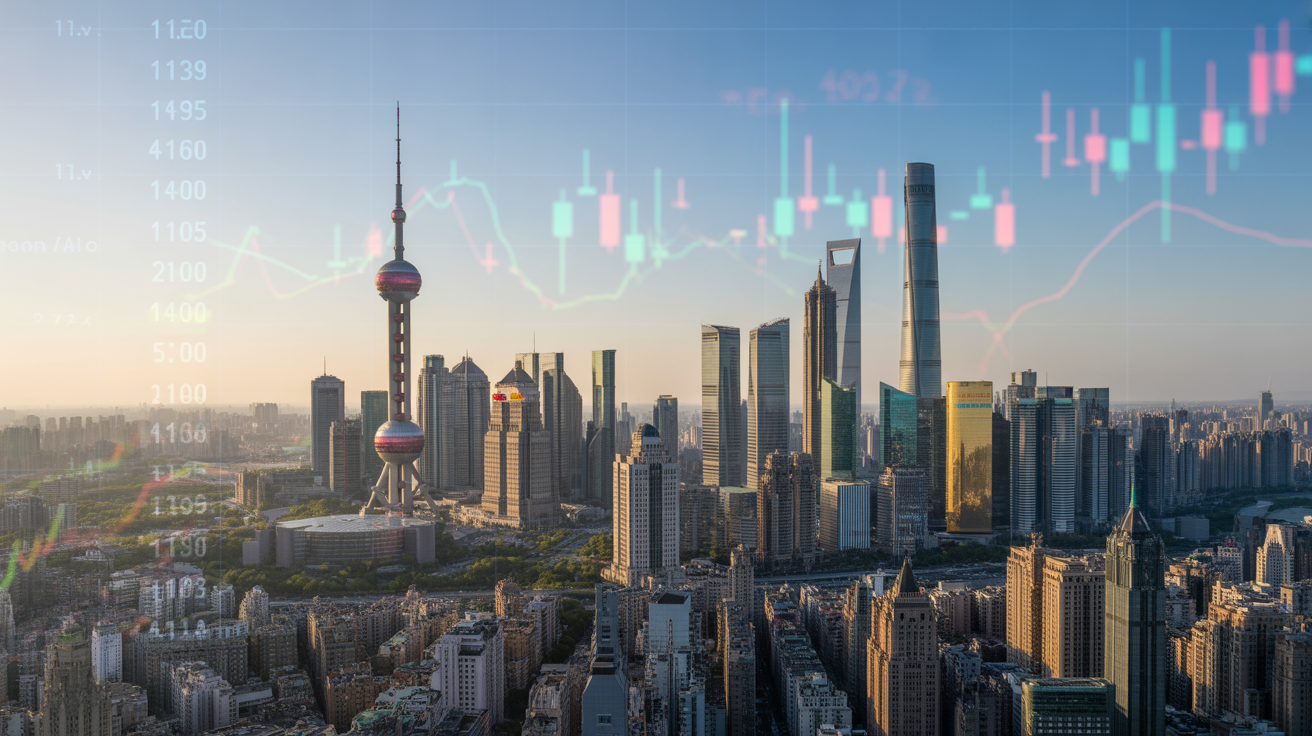
It always seems to happen the same way. Just when investors around the world start feeling comfortable again, China’s markets throw a curveball. One month it is a roaring rally in tech stocks, the next it is worries about property debt, weak consumer spending, or a surprise policy shift. Lately, the mood has tilted cautious. Growth is cooling, confidence has wobbled, and headlines keep asking whether China’s economic miracle is running out of steam.
But here is the real question that matters for anyone with money at work. Is this slowdown the start of something darker, or is it simply another chapter in a long story of reinvention and opportunity?
I have watched China’s markets in one form or another for over two decades, through the World Trade Organization boom, the 2008 stimulus wave, the tech surge, and the property frenzy. If there is one lesson that keeps coming back, it is this: betting against China has been a losing trade more often than not. Yet, blind optimism has burned more than a few fingers too. The truth often sits in an uncomfortable middle.
Right now, we are at one of those crossroads. Growth is slower. Risks are real. But under the surface, the market is also quietly resetting in ways that long term investors usually dream about.
So let’s unpack what is really going on in China’s markets, where the fears are justified, and where the opportunities might be hiding.
A Market Catching Its Breath
China’s economy is not shrinking. It is just running at a slower pace than what the world grew used to over the past twenty years. For many investors, that slowdown feels dramatic because expectations were built on years of blistering expansion. When an economy shifts from 10 percent growth to 5 percent, even if that 5 percent still beats most of the world, it can feel like the engine has stalled.
One of the biggest drags has been the property sector. For years, real estate was the backbone of local government finance and household wealth. Apartments were not just homes. They were savings accounts, retirement plans, and speculative assets wrapped into one. When developers overextended and regulators moved in to rein things back, the correction was inevitable. What surprised many was how long and how deep it ran.
Developers missed bond payments. Buyers delayed purchases. Construction slowed. Confidence took a hit. And because property touches everything from steel to cement to household appliances, the ripple effects spread wide.
At the same time, global demand softened. Exports, once a reliable growth engine, faced pressure from weak overseas consumption and rising geopolitical tension. Manufacturers that once ran at full capacity began to see thinner order books.
Add in a stock market that struggled to regain its footing after several sharp selloffs, and you get the uneasy mood that has defined much of the recent narrative.
Yet here is the part that often gets lost. Slowdown does not mean stagnation. It means the economy is changing shape.
The Consumer Is More Cautious, but Not Gone
Walk through a shopping district in Shanghai, Shenzhen, or Chengdu today and you will still see crowds. Restaurants are busy. Cafes buzz with young professionals staring into laptops. Malls still sell luxury handbags and smartphones at eye watering prices. The idea that Chinese consumers have suddenly shut their wallets is not entirely accurate.
What has changed is behavior. Consumers are more selective. They look for value. They wait for discounts. They are quicker to cut back on big ticket items like cars and homes. Experiences, travel, and everyday indulgences are holding up better than heavy spending.
This shift has real implications for investors. It favors companies that target middle class spending with smart pricing and strong brands. It hurts those relying on easy credit driven splurges.
One fund manager I spoke to recently told me this reminded him of the period right after the 2015 market crash. “People did not stop spending,” he said. “They just became smarter about it.”
That same pattern is reappearing today.
The Government Still Has Firepower
Anyone who has followed China for more than five minutes knows one thing. The state does not like chaos in its financial system. When stress builds, policymakers eventually step in.
We have already seen selective interest rate cuts, support for banks to lend more to small businesses, and moves to stabilize the property market without reigniting the same excesses. Unlike 2008, when a massive stimulus flooded the economy with cash, today’s approach is more targeted and measured.
Some investors see that as a problem. They want bold, sweeping action. But there is another way to read it. The leadership is trying to strike a balance between short term support and long term financial health.
China still sits on considerable policy tools. Interest rates remain relatively high compared to many developed markets. Government debt, while rising, is far from the levels seen in the United States or Europe. That gives Beijing room to maneuver if conditions worsen.
Markets know this. They may not cheer every incremental move, but there is a quiet assumption that officials will not let the system unravel.
A Reset in Valuations
Here is where the opportunity starts to peek through the gloom.
After years of turbulence, many Chinese stocks now trade at valuations that would have seemed unthinkable during past bull runs. Price to earnings ratios have compressed. Dividend yields have risen. Even strong, cash generating businesses are now priced as if growth is a thing of the past.
To put this into perspective, here is a simple snapshot comparing general valuation ranges across major regions:
| Market | Typical P/E Range | Recent Average Dividend Yield |
|---|---|---|
| China | 9 to 12 | 3.5 to 4.5 percent |
| United States | 18 to 23 | 1.5 to 2 percent |
| Europe | 13 to 17 | 2.5 to 3.5 percent |
| Japan | 14 to 18 | 2 to 3 percent |
These are broad numbers, not precise metrics, but they tell a clear story. On valuation alone, China is cheap relative to most major markets.
Of course, cheap can always get cheaper. But low valuations often reflect fear, not fundamentals. For investors with patience, that combination has historically been fertile ground.
The Tech Sector Is No Longer Untouchable, But It Is Not Dead
There was a time when China’s internet giants seemed unstoppable. E commerce platforms, gaming firms, social media empires all grew at breathtaking speed. Then came the regulatory crackdown. New rules reshaped business models, capped profits in certain areas, and erased hundreds of billions in market value almost overnight.
For many foreign investors, it was a rude wake up call. Political risk was no longer theoretical. It was visible on the screen.
Fast forward to today, and the dust has largely settled. Regulation remains strict, but predictable. The companies that survived the shakeout have adapted. They trimmed excesses, refocused on core businesses, and found ways to grow within the new rules.
Cloud services, artificial intelligence, digital payments, and enterprise software continue to expand. The growth rates are lower than the wild days of the past, but they are steadier and more sustainable.
In many ways, this looks less like the end of China tech and more like its maturation. The stocks reflect that shift. They are no longer priced for explosive expansion. They are priced like businesses.
For long term investors, that can be a blessing in disguise.
Manufacturing Is Evolving, Not Vanishing
Another popular narrative says China’s manufacturing edge is fading as companies diversify into Vietnam, India, and Mexico. There is truth here. Global firms want to reduce dependence on a single country. Supply chains are being rearranged.
But what often gets missed is how China’s manufacturing base itself is moving up the value chain. Low margin, labor intensive production is gradually giving way to high tech manufacturing, robotics, electric vehicles, batteries, and advanced machinery.
Take electric vehicles as an example. China is now the largest EV market in the world by a wide margin. Domestic brands dominate sales at home and are pushing aggressively into Europe, Southeast Asia, and beyond. Battery makers, chip designers, and materials suppliers sit behind this expansion.
This is not the old image of China as a cheap factory floor. It is China as a high tech industrial powerhouse.
Investors who still view the country through a 1990s lens risk missing this structural shift.
Geopolitics: The Shadow Every Investor Must Accept
It would be dishonest to talk about China’s market without addressing geopolitics. Tensions with the United States, trade restrictions, technology bans, and shifting alliances all add layers of uncertainty that simply do not exist in many other markets.
For portfolio managers, this complicates life. A stock can be cheap and profitable and still be uninvestable for some funds due to political risk. Sanctions, export controls, or sudden policy changes can disrupt entire sectors.
This is not a small issue. It is part of the permanent risk premium attached to Chinese assets today.
At the same time, markets have a habit of adapting. Companies restructure supply chains. Domestic demand grows more important. Regional trade within Asia deepens. While geopolitics caps certain upside scenarios, it rarely freezes an economy in place.
Investing in China now requires accepting that you are being paid, through lower valuations, to shoulder this uncertainty.
Domestic Investors Are Still in the Game
One of the less discussed but crucial aspects of China’s markets is the role of domestic investors. Unlike in many emerging markets where foreign flows dominate price action, China’s onshore market is heavily driven by local money.
Millions of retail investors trade daily. Pension funds and insurance companies allocate steadily. State linked funds step in during periods of severe stress to stabilize prices.
This creates a different market rhythm. Sharp selloffs can bounce unexpectedly when policy support or domestic confidence returns. At the same time, euphoric rallies can fade just as quickly.
If you are used to the behavior of Wall Street or European bourses, China can feel like a different species. That is not necessarily a bad thing. It simply requires a different mindset.
A Personal Story from the Trading Desk
Let me share a small moment that still sticks with me. Years ago, during another ugly spell for Chinese stocks, I was sitting next to a veteran trader in Hong Kong. The screens were red. Foreign investors were dumping positions. Headlines screamed about capital flight and hard landings.
I asked him if he was worried. He smiled and said, “Everyone is scared. That is usually when you start looking for bargains.”
He was not blindly bullish. He reduced risk where it made sense. But he also carefully picked up positions in companies with strong balance sheets and real cash flow. Over the following two years, many of those stocks quietly doubled while global attention chased other fads.
That lesson is not a guarantee of future profits, but it does capture the rhythm of investing in China. Extremes of fear and enthusiasm come and go faster here than in most markets.
Where the Opportunities May Be Hiding
Opportunities today are not concentrated in one obvious place. They are scattered across different themes.
First, high quality consumer brands that cater to everyday spending rather than luxury splurges look well placed. Food, beverages, affordable apparel, and domestic travel continue to see steady demand.
Second, dividend paying financials and industrials offer income in a world where yields are finally back in focus. Some state owned enterprises are paying dividends that rival or exceed those in developed markets.
Third, the energy transition remains a powerful long term driver. Solar, wind, batteries, electric vehicles, and grid infrastructure are not just national priorities. They are global growth trends where Chinese firms hold deep expertise.
Fourth, healthcare and biotech are quietly building momentum as the population ages and demand for advanced treatment rises. These are more volatile plays, but the demographic tailwind is hard to ignore.
Each of these areas comes with its own risks, but collectively they paint a more nuanced picture than simple doom and gloom.
The Risks That Cannot Be Ignored
All of this opportunity talk would ring hollow without a clear look at the dangers.
The property sector remains fragile. A disorderly unwind could still spill into the banking system or consumer confidence.
Local government debt is high, tied closely to land sales and infrastructure spending. If revenue continues to weaken, fiscal strains could deepen.
Capital controls and regulatory unpredictability remain structural issues for foreign investors.
And perhaps most important of all, demographics are turning from a tailwind into a headwind. An aging population and shrinking workforce pose long term challenges to growth potential.
These are not passing shadows. They are real constraints that will shape China’s economy for years.
Slowdown or Opportunity? It Depends on Your Horizon
Short term traders hate uncertainty, and China offers it in abundance. Volatility around policy announcements, economic data, or geopolitical headlines can punish those with itchy trigger fingers.
Long term investors often see the same uncertainty as opportunity. Slower growth compresses valuations. Fear pushes prices below intrinsic value. Structural shifts create new leaders while old champions fade.
China today feels like a market in transition. The easy gains of the early growth years are gone. But transition does not mean terminal decline. It means the rules are changing.
If you expect China to behave like a young, hyper growth economy forever, disappointment is guaranteed. If you view it as a massive, complex, middle income giant finding a more mature footing, the picture becomes more interesting.
Practical Takeaways for Investors
So what does all of this mean in real terms for people trying to make smart decisions with their money?
First, diversify your exposure. China should not be an all or nothing bet. It works best as part of a broader portfolio where risks are spread across regions and asset classes.
Second, focus on quality. Balance sheets matter more than ever. Companies with low debt, strong cash flow, and defensible market positions are best equipped to ride out policy shifts and economic slow patches.
Third, be patient. China rarely moves in straight lines. Periods of underperformance can last longer than expected, but rebounds can be swift when sentiment turns.
Fourth, respect political risk. It is not noise. It is part of the investment equation. Price it into your expectations from day one.
Finally, avoid chasing headlines. The loudest stories in China’s market are often already in the price by the time they dominate the news cycle.
A Clear Eyed, Optimistic Conclusion
China’s market today sits at an uncomfortable intersection of global anxiety and quiet domestic resilience. Growth has slowed. Structural challenges are real. Geopolitical risks have not faded into the background. All of that deserves respect.
At the same time, this is still a country of unmatched scale, deep industrial capacity, fast moving innovation, and a consumer base that continues to grow in sophistication even as it tightens its belt. Valuations have reset. Excess has been wrung out of key sectors. The froth is mostly gone.
For those willing to look past the noise, China no longer feels like a casino table where everything depends on the next policy headline. It feels more like a messy, uneven investment landscape where careful choices can pay off over time.
So is this a slowdown or an opportunity?
In truth, it is both. The slowdown is real and likely to persist in some form. The opportunity lies in how markets have reacted to it. Fear has created discounts. Uncertainty has reshuffled winners and losers. And transition has opened doors for businesses that fit the new shape of China’s economy.
For investors with a steady hand and a long view, this moment might one day be remembered not as the point where China’s story ended, but as the chapter where it quietly reloaded for the next phase.
In markets, as in life, the loudest moments often mask the most important shifts happening underneath. China’s market moves today are no exception.