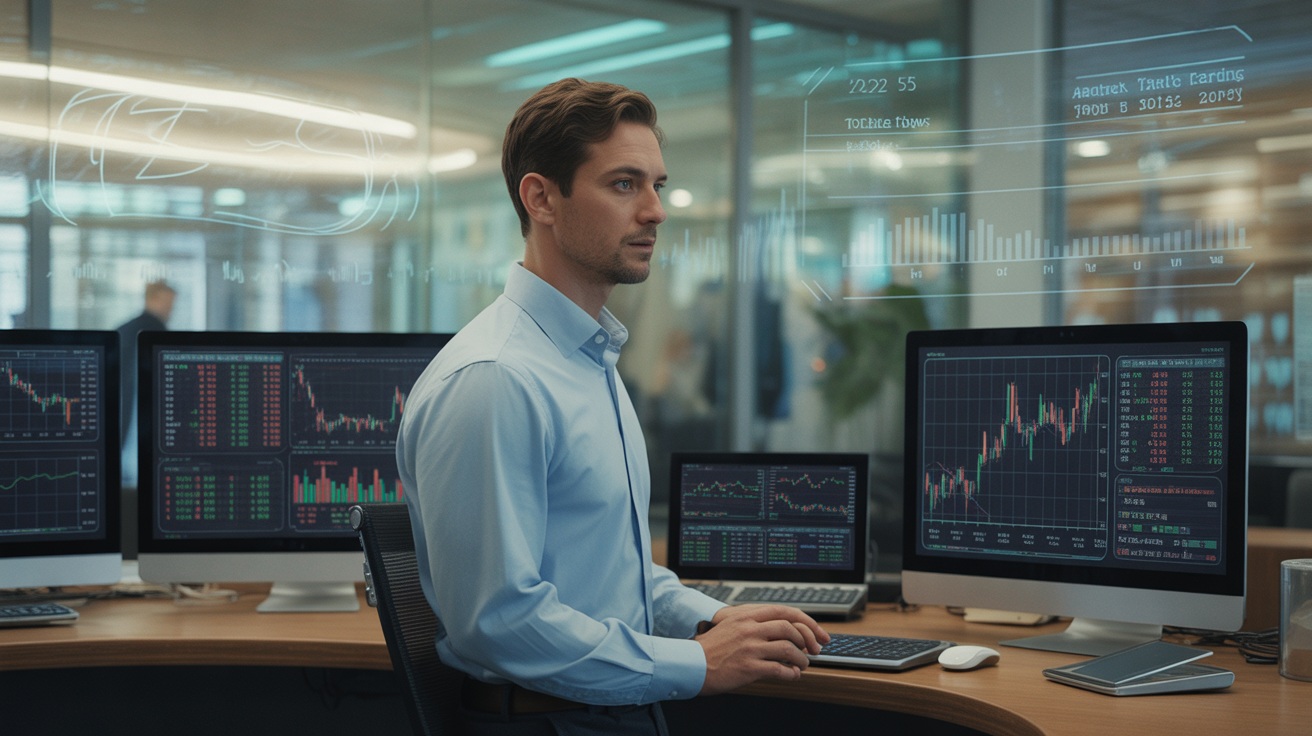
A few years back, I watched a young trader in a co-working space place a dozen trades in under a minute. No frantic mouse clicks. No shouting at the screen. Just a quiet laptop, a cup of cold coffee, and a calm smile. “The system’s doing the work,” he said. That moment stuck with me because it captured what today’s markets really look like. The noise we see on financial news is just the surface. Underneath it all, algorithms are moving billions of dollars every day.
As we roll toward 2025, algo trading is no longer the playground of hedge funds alone. Retail traders run bots on cloud servers. Crypto investors automate strategies while they sleep. Even long-term investors use rule-based systems to manage risk. The question is no longer whether algorithms dominate markets. They already do. The real question is this: which strategies actually make sense for the market we are stepping into next?
Interest rates have settled into a new rhythm after years of chaos. Artificial intelligence is changing how signals are generated. Crypto markets are more regulated but still wildly volatile. And retail participation remains stubbornly strong. In that mix, certain automated strategies are pulling ahead of the pack.
In this article, I will walk you through the top five automated trading strategies for 2025. Not as textbook theory, but as real tools with real trade-offs. You will see how they work, where they shine, where they fail, and what kind of investor should even consider using them. Think of this as a field guide, not a sales pitch.
Let’s get into it.
Why 2025 Is a Turning Point for Algo Trading
Markets evolve in cycles. For most of the 2010s, cheap liquidity lifted almost every asset. Then came the inflation shock, aggressive rate hikes, and sharp rotations between growth and value. Algorithms that assumed smooth trends got whipsawed. Many blew up quietly.
Now, heading into 2025, we are in a different environment. Volatility still spikes, but it feels more structured. Macro data moves markets in recognizable patterns again. Liquidity has returned to major venues. Machine learning tools are more accessible than ever. And perhaps most important, regulators across the US, Europe, and parts of Asia have built clearer frameworks around automated trading, especially in crypto.
That combination favors strategies that are disciplined, adaptive, and risk-aware. Wild, over-leveraged bots chasing every tick are falling out of favor. Robust systems with defined edges are taking their place.
The Top 5 Automated Trading Strategies for 2025
Here is the quick snapshot before we dig deeper.
| Strategy | Core Idea | Best Markets | Strength | Main Risk |
|---|---|---|---|---|
| Trend Following 2.0 | Ride confirmed price trends with adaptive filters | Stocks, futures, crypto | High staying power | Gets chopped in sideways markets |
| Mean Reversion with AI Filters | Trade temporary mispricings | Equities, ETFs, crypto | High win rate in ranges | Can suffer in strong breakouts |
| Statistical Arbitrage | Exploit pricing inefficiencies between related assets | Equities, futures | Market-neutral returns | Model decay over time |
| Volatility Breakout Systems | Trade explosive moves after compression | Forex, crypto, indices | Big upside in news cycles | False breakouts |
| Market Making with Smart Inventory Control | Profit from bid-ask spreads while managing risk | Crypto, liquid equities | Consistent small gains | Sudden large price moves |
Now let’s unpack each one in real-world terms.
1. Trend Following 2.0: The Old Giant Reinvents Itself
If algo trading had a hall of fame, trend following would be one of the first inductees. Buy strength. Sell weakness. Let winners run. Cut losers quickly. Simple in theory. Brutal in practice. Yet it still works.
What has changed by 2025 is how trends are identified and filtered. The classic moving-average crossover is no longer enough. Modern trend systems stack multiple confirmations: volatility regimes, volume behavior, macro filters, and even sentiment derived from news feeds.
A hedge fund manager once told me, “Trends pay the rent, but only if you know when not to follow them.” That line sums up the evolution perfectly. Trend Following 2.0 is less about always being in the market and more about being in only when the odds are strongly skewed.
How It Works in Practice
Imagine an automated system trading Nasdaq futures. It waits for three conditions:
-
Medium-term momentum turns positive.
-
Volatility is expanding from a low base.
-
Macro data is not flashing extreme risk-off signals.
Only then does it enter. Position size adjusts automatically based on recent volatility. Exits are driven by trailing stops that widen in strong trends and tighten when momentum slows.
In 2023 and 2024, these smarter trend systems quietly made money in energy futures, certain tech stocks, and major crypto assets during sustained runs. They avoided many of the brutal chop zones that killed simpler systems.
Why It Matters in 2025
We are likely heading into another period of sector rotations rather than an everything-rallies-together market. That is perfect soil for trend followers who can switch gears without emotion.
The Catch
When markets go flat, trend systems bleed slowly. No amount of clever coding completely eliminates whipsaws. You have to accept small repeated losses as the cost of catching the big wave.
2. Mean Reversion with AI Filters: The Comeback Kid
For years, mean reversion was the darling of short-term traders. Buy what is beaten down. Short what is overheated. Then something changed. Volatility exploded. Prices stayed irrational longer than many systems could stay solvent.
Now, with better real-time data and machine learning filters, mean reversion is back in style. Not in its old, rigid form, but as a far more selective approach.
The Key Upgrade
Traditional mean reversion assumed prices naturally snap back like a rubber band. Modern systems ask a smarter question first. Is this move likely an emotional overreaction or the start of a genuine shift?
AI models trained on years of price action, order flow, and macro events now act as gatekeepers. They allow trades only when the probability of reversion crosses a statistically meaningful threshold.
A Real Example
Consider an automated bot trading large US bank stocks. After a sudden sell-off tied to a scary headline, the system checks:
-
Was the volume extreme or average?
-
Did credit spreads move aggressively?
-
Did peer stocks show similar stress?
If the signals suggest panic more than structural damage, the bot fades the move. Often, those bounces come fast and deliver clean profits within hours or days.
Why It Shines in 2025
Markets today react violently to information, especially in the age of social media and instant headlines. Many of those reactions overshoot reality. AI-filtered mean reversion is built to exploit that gap between emotion and facts.
The Risk
When the market truly breaks, mean reversion gets steamrolled. The same model that buys dips in normal corrections can keep buying all the way down in a real crash unless strict risk controls are in place.
3. Statistical Arbitrage: Quiet Profits in the Background
If trend following is flashy and mean reversion is scrappy, statistical arbitrage is the quiet professional in the room. It does not care whether the market is bullish or bearish. It cares about relationships between assets.
Pairs trading is the most familiar form. Two stocks with a long history of moving together drift apart. The system shorts the outperformer and buys the underperformer, betting on a return to balance.
In 2025, stat arb systems go far beyond simple pairs.
How Modern Stat Arb Works
A typical institutional stat arb engine might monitor thousands of relationships:
-
Equity pairs within the same sector.
-
Futures spreads across different contract months.
-
Cross-asset correlations, such as equity versus volatility products.
The models constantly retrain themselves to adapt to new market behavior. Execution algorithms break large trades into tiny pieces to reduce market impact. It is a world of razor-thin edges and relentless optimization.
Why It Still Works
Markets are efficient, but they are not perfectly efficient. Temporary mispricings still appear due to fund flows, hedging needs, and forced liquidations. Stat arb lives in those cracks.
During the banking tremors of the early 2020s, for instance, relationships between different classes of financial stocks broke down violently. Some stat arb desks had rough weeks. Others, with adaptive models, made their best profits in years.
Retail Access in 2025
Ten years ago, this game was almost entirely institutional. Today, retail traders can run simplified versions on cloud platforms with APIs to major brokers. The profits are smaller, the costs proportionally higher, but the principle is the same.
The Downside
Model decay is the silent killer. What works this year may stop working next year as market structure changes. Continuous research is not optional. It is the price of entry.
4. Volatility Breakout Systems: Thriving on Chaos
Every trader knows that eerie feeling when a market goes dead quiet. Volume dries up. Price compresses into a tight range. Then, out of nowhere, it explodes. Volatility breakout systems are built specifically for those moments.
These systems do not chase trends or fade extremes. They wait. Patiently. Almost stubbornly. Their job is to detect when a market has coiled like a spring and is ready to snap.
The Logic
The core idea is simple:
-
Identify periods of historically low volatility.
-
Place conditional orders above and below the current price.
-
When price breaks out with force, jump on the move immediately.
Modern breakout bots refine this with volatility regimes, time-of-day filters, and even news-aware scheduling.
Where They Work Best
-
Forex around central bank decisions.
-
Crypto markets during major regulatory or ETF announcements.
-
Equity indices ahead of earnings seasons.
I still remember watching a simple breakout bot on a Bitcoin chart in 2020. It did nothing for weeks. Then one night, during a sudden surge, it fired a single trade that paid for two months of quiet losses in under an hour. That is the nature of this strategy. Long waiting. Short bursts of action.
Why 2025 Is Fertile Ground
We are in an era of compressed expectations followed by violent repricing. Inflation data. Geopolitics. AI regulation. Crypto policy. All of these generate volatility clusters that breakout algorithms love.
The Weak Spot
False breakouts are the enemy. A market can poke its head above a range, trigger the system, and collapse minutes later. Without tight risk management, a string of fake moves can grind down an account.
5. Smart Market Making: The Merchant of the Digital Age
Market making feels almost old-fashioned. The idea of standing in the middle, buying at the bid and selling at the ask, collecting the spread like a quiet toll. Yet in the age of crypto and high-speed electronic markets, it has become one of the most sophisticated automated strategies out there.
Retail traders used to be terrified of market making. Too complex. Too fast. Too institutional. That has changed.
How Smart Market Making Works
An automated market maker posts both buy and sell orders around the current market price. As trades fill, it adjusts inventory and prices dynamically. The goal is not to predict direction but to manage exposure while capturing tiny edges repeatedly.
Modern systems use:
-
Real-time order book analysis.
-
Volatility-adjusted spreads.
-
Automated hedging across correlated markets.
On a good day, a market maker might execute hundreds or thousands of tiny trades, each one barely noticeable on its own, but powerful in aggregate.
Where It Thrives in 2025
-
Major crypto pairs like BTC and ETH.
-
Highly liquid equity ETFs.
-
Certain futures contracts with deep order books.
As traditional finance and digital assets continue to merge, liquidity keeps improving. That is fuel for market making.
The Risk Nobody Talks About
Sudden one-way markets. A shock announcement hits. Price gaps violently. The system that was happily collecting spreads finds itself loaded with inventory on the wrong side. Without hard stop rules, losses can snowball fast.
Opportunities and Risks: The Two Sides of the Coin
Algo trading in 2025 feels both more accessible and more dangerous than ever. Barriers to entry have fallen. Code libraries, data feeds, broker APIs, and cloud servers are cheap and plentiful. A disciplined retail trader can now deploy strategies that once required a quant desk.
But the risks have evolved too.
The Opportunities
-
Emotional discipline by design. Algorithms follow rules. They do not panic, chase, or hesitate.
-
Speed and consistency. Machines execute in milliseconds and apply identical logic every time.
-
Scalability. A strategy that works on one market can often be adapted to many.
-
Diversification. Multiple automated strategies can operate together, smoothing returns.
The Hidden Risks
-
Over-optimization. Backtests can look perfect and fail miserably in live markets.
-
Execution risk. Slippage, latency, and partial fills can quietly erode profits.
-
Black swan events. Systems are trained on history. The future still surprises us.
-
Psychological distance. Watching a machine lose money can feel strangely worse than making the mistake yourself.
One veteran trader put it bluntly: “Algorithms remove emotion from trading, but they don’t remove emotional consequences.”
How Investors Can Use These Strategies Without Blowing Up
Not everyone needs to build their own trading bot from scratch. In fact, most people probably should not. Still, there are practical ways to engage with algo trading intelligently.
1. Start with One Strategy
Mixing five systems at once may sound diversified, but it often creates confusion. Pick one approach that matches your personality. If you like patience and big moves, explore breakouts. If you prefer steady action, look at market making or mean reversion.
2. Trade Small, Even When You Think You Are Ready
The fastest way to expose hidden flaws in a system is to run it live with real money, even in tiny size. Paper trading teaches mechanics. Live trading teaches psychology and execution reality.
3. Monitor, Do Not Micromanage
An algo that needs constant human intervention is not really automated. Set daily or weekly check-ins. Review performance, slippage, and unexpected behavior. Then let the system do its job.
4. Always Know the Kill Switch
Every automated trader needs a hard rule for when the system shuts down. Max daily loss. Max weekly loss. Technical failure. No exceptions. Discipline is easier to enforce when it is written into code.
5. Think Like a Portfolio Manager, Not a Gambler
Algorithms shine when they are treated as long-term tools, not lottery tickets. Smooth curves beat wild equity swings. Consistency outperforms drama.
What the Big Players Are Doing Differently in 2025
Institutional desks are not chasing flashy strategies. They are obsessed with robustness. Most run dozens or even hundreds of small edges simultaneously. Each one may generate only modest returns, but together they create a powerful machine.
They also invest heavily in:
-
Redundant systems to avoid downtime.
-
Real-time risk dashboards.
-
Cross-market hedging rather than isolated trades.
Retail traders can learn a crucial lesson from this. Survival comes before profits. If your system cannot survive bad months, it will never see the good ones.
The Human Element in a Machine-Driven Market
Here is the paradox people rarely talk about. The more automated markets become, the more valuable human judgment grows at the strategic level.
Machines are brilliant at execution. They are terrible at meaning. They do not know why a central bank chair hesitated before answering a question. They do not feel the shift in political mood. They do not sense when a narrative is cracking before the charts reflect it.
The best algo traders in 2025 are not just coders. They are observers of human behavior who translate that intuition into rules.
I once met a former floor trader who now runs a fully automated futures system. His strategy logic is simple. His code is not fancy. What makes it work is his deep sense of when markets are lying and when they are telling the truth. The algorithm is just the vehicle.
A Look Ahead: Where Algo Trading Is Headed Next
By the end of this decade, we will likely see even tighter integration between AI, natural language processing, and real-time trading systems. Bots already read earnings transcripts and headlines. Soon they will interpret tone, contradiction, and narrative shifts almost as well as humans.
At the same time, regulation will continue to shape how fast and how freely these systems operate. Especially in crypto, the wild west phase is fading. That is good news for serious traders and bad news for reckless gamblers.
One thing seems certain. The market of 2025 will reward preparation far more than prediction.
Conclusion: The Smart Machine Still Needs a Smart Operator
Algo trading is no longer a futuristic concept. It is the backbone of modern markets. Whether you trade stocks, futures, forex, or crypto, you are already competing against machines every time you click buy or sell.
The top automated strategies for 2025 reflect that reality. Smarter trend following. AI-filtered mean reversion. Adaptive statistical arbitrage. Volatility breakouts tuned for news-driven markets. And streamlined market making that turns liquidity itself into a source of return.
Each of these approaches offers real opportunity. And each carries real risk. There is no magic formula that prints money without drawdowns, frustration, and the occasional sleepless night.
The advantage today is choice. You can observe. You can test. You can start small. You can learn from both the triumphs and the failures of those who came before you.
In the end, successful algo trading is not about building the fastest bot or the smartest model. It is about building a system that fits your temperament, respects risk, and can survive long enough for probability to do its work.
The machines may place the trades, but the responsibility still rests with us. And in 2025, that responsibility has never been more exciting or more serious.